
AI Mode and AI Overviews Are Not the Same Thing. Here's What Changes for Your Content Strategy
Google AI Overviews and AI Mode use the same engine but pull answers differently. Optimizing for one won't guarantee visibility in the other. Here's what each surface rewards and how to plan for both.
AI Mode and AI Overviews Are Not the Same Thing. Here's What Changes for Your Content Strategy
Google runs three separate AI surfaces that all feel like "search with AI." They share the same underlying engine, but they pull answers from different depths, serve different intents, and reward different content structures. Treating them as one thing is how brands optimize for the wrong surface and wonder why visibility doesn't hold.
The Omnibound team broke this down well in a September 15 analysis: AI Overviews, AI Mode, and Gemini are three distinct products with three distinct paths to a citation. If you are building a content strategy around "show up in AI search," you need to know which surface you are targeting and why.
AI Overviews: The Passive Summary
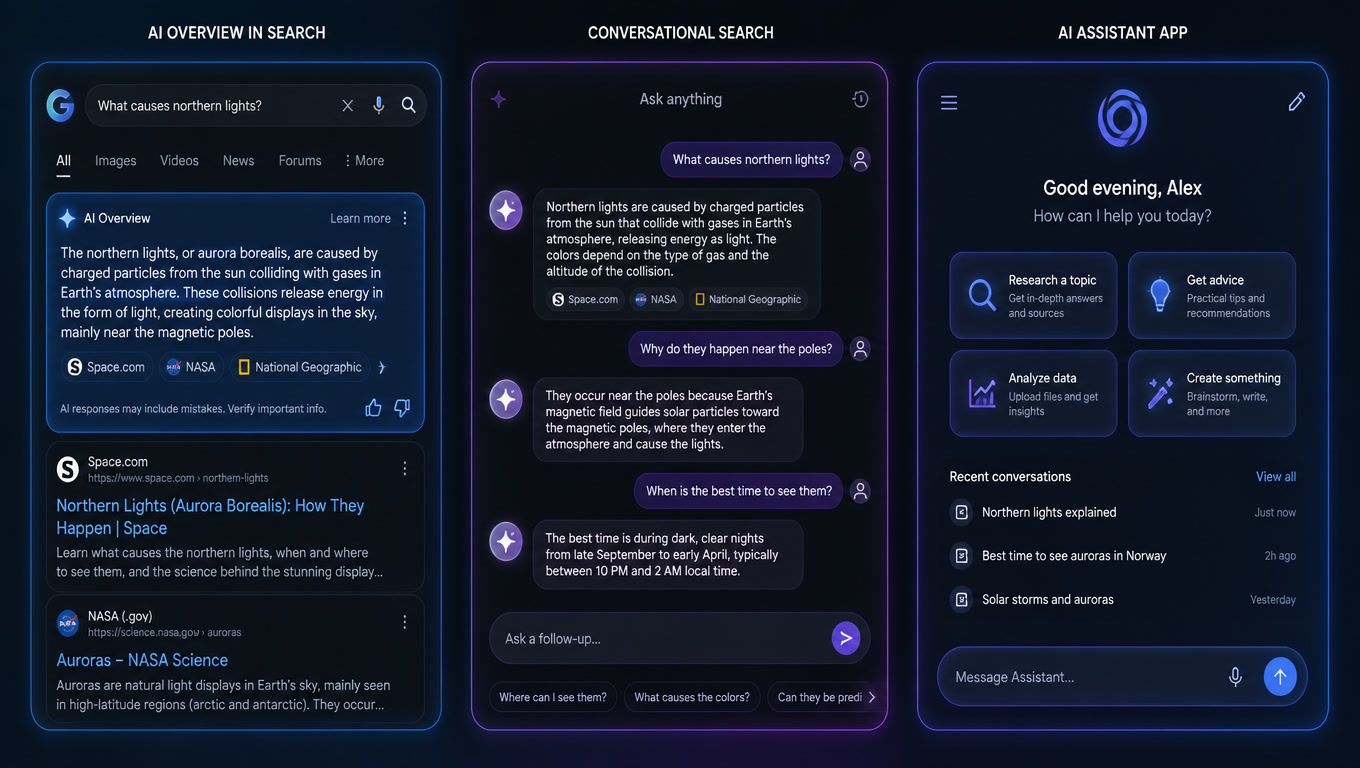
AI Overviews are the generated answer boxes that appear at the top of a regular Google search. You do not opt into them. They show up automatically when Google decides an AI summary adds value for that query.
How they work under the hood:
- Google runs the search, expands the query, and pulls from pages it already ranks and trusts.
- The answer is a single synthesis with citation cards linking to a handful of sources.
- It sits on top of the results page the buyer was already going to see.
What this means for your content: AI Overviews reward pages that answer a specific query cleanly and directly. Think structured answers, clear definitions, and content that Google can extract a two-to-three sentence summary from without losing meaning. If your page already performs well for featured snippets, you are in reasonable shape here.
The catch is that "reasonable shape" is no longer enough. Appearing in an AI Overview summary can be more valuable than a page-one ranking because it sits above everything else. Being excluded means your brand is invisible at the top of the page, even if you rank fourth or fifth in the blue links below.
AI Mode: The Opt-In Conversation
AI Mode is a dedicated tab inside Google Search. Users actively choose it. Instead of one answer, they get a back-and-forth where context carries from one turn to the next.
Two things make AI Mode fundamentally different from AI Overviews:
Query fan-out. When someone asks a question in AI Mode, Google breaks it into multiple sub-searches and pulls sources for each. Google has described this as running up to 16 simultaneous searches for a single query. That means your content does not need to rank for the original query. It needs to be the best source for one of the sub-questions the system generates.
Multi-source synthesis. AI Mode builds a longer, more detailed answer from many sources. It can also personalize responses using the buyer's Google account history and connected apps. Two people asking the same question might see different sources cited.
What this means for your content: AI Mode rewards topic depth, not single-page optimization. A brand that has one strong page on a topic might appear in AI Overviews. A brand that has built a cluster of pages covering the surrounding sub-questions is far more likely to surface in AI Mode because the fan-out process reaches into more of your content.
Gemini: The Third Surface
Gemini is a standalone assistant outside of Google Search entirely. People use it the way they use ChatGPT: drafting, summarizing, comparing, asking open-ended questions.
Gemini can ground its answers in current web information, but it does not lean on the same search index as AI Overviews and AI Mode. Its path to an answer is different. For B2B and service businesses, Gemini matters because buyers increasingly ask an assistant for shortlists and recommendations directly. When someone types "best marketing automation tools" into Gemini, the answer comes from what the model knows and can retrieve, not from a ranked page you optimized.
You cannot control what Gemini recommends. But you can make sure your brand's presence across the web tells a consistent, authoritative story that any model would have reason to surface.
The Practical Difference
Here is the core tension: a page that works perfectly for AI Overviews might be completely absent from AI Mode, and vice versa.
AI Overviews pull from pages Google already trusts. If your content ranks well and answers the query directly, you have a shot. The optimization is page-level.
AI Mode pulls from a web of related sources. If your site has depth on a topic, covering the questions that surround the main query, you are more likely to appear because the fan-out process finds your other pages. The optimization is site-level.
A common mistake is checking your brand visibility in one surface and assuming it holds across all three. It usually does not. A brand that appears in AI Overviews on a regular search might be completely missing from AI Mode for the same topic. A brand that dominates AI Mode might not show up in the Gemini app at all.
What to Do About It
Start by mapping where your buyers actually meet these surfaces. Take five to ten of your priority buyer questions and run each one three ways:
- As a normal Google search. Watch for an AI Overview and note which sources get cited.
- Inside AI Mode. Ask the same question and see which sources appear in the conversational answer.
- In the Gemini app. Ask the same question and see what the assistant recommends.
The gaps between those three results are your roadmap. If you show up in AI Overviews but not in AI Mode, you need more topic depth. If you show up in neither, start with the basics: clean, direct answers to specific queries, structured data, and content that Google can confidently cite.
For AI Overviews specifically, structure content around direct answers. Use clear headings that match the question someone would type. Provide definitions, comparisons, and step-by-step processes that Google can summarize in two or three sentences.
For AI Mode, build topic clusters. Instead of one definitive page on a subject, create a set of pages that address the surrounding questions a buyer would ask during research. Link them together. The more of your content Google can pull from during fan-out, the more likely you are to appear in the synthesized answer.
For Gemini, focus on brand authority. Make sure your content, earned media, and customer-generated material tell a consistent story about what you do and why you are credible. Gemini draws on entity-level authority across the web, not just your site.
The Bottom Line
Google's AI search is not one surface. It is three, and each one pulls from different depths of content. Optimizing for one does not guarantee visibility in the other. The brands that win will be the ones that understand the difference and build for each surface separately.
Check your visibility across all three. Then fix the gaps.
Frequently Asked Questions
What is the difference between Google AI Overviews and AI Mode?
AI Overviews are automatic summaries that appear at the top of standard search results. AI Mode is a separate conversational tab inside Google Search where users ask follow-up questions and get multi-source answers. Both use Gemini models but pull from different depth of content.
Do I need separate optimization strategies for AI Overviews and AI Mode?
Yes. AI Overviews reward pages that answer a specific query cleanly, similar to featured snippets. AI Mode rewards topic depth and authority across a cluster of related pages, because it runs multiple searches per query and synthesizes from many sources.
Can a page rank well in traditional search but still miss AI Mode?
Absolutely. AI Mode uses query fan-out, breaking one question into many sub-queries and pulling from sources that may not be on page one of any single query. A page can be invisible in AI Mode while ranking normally in classic results.