

AI Story Optimization: the ghost think tank that's poisoning AI answers
A fake think tank got ChatGPT and Perplexity to cite its byline-less reports. The case is documented. How to defend your brand's AI citations.
AI Story Optimization: the ghost think tank that's poisoning AI answers
A fake think tank published more than 100 byline-less "reports" in eight days and got ChatGPT and Perplexity to cite them in neutral answers. This is not speculation: the case has a contract, a documented payment, and direct engine behavior to back it up. The technique is called AI Story Optimization, it's sold openly as a service, and it's already shaping what AI answers say. Here's what happened, why it works, and how to protect your brand.
What happened: the Hanover Institute doesn't exist
In early August, the website of the Hanover Institute for Public Policy appeared: a serious-looking think tank publishing "reports" on Gaza, antisemitism, and international politics. The catch: none of the 100+ articles has an author. They all went live between August 6 and August 14, in one week. POLITICO broke the story on August 14: the site was created by Piro, Inc. on behalf of the Israeli government's advertising agency, routed through Havas Media Germany, for roughly $900,000.
On August 17, Responsible Statecraft confirmed the investigation with the telling detail: the page carries a disclosure at the bottom saying the material was distributed by Piro on behalf of the Israeli government. A GPTZero analysis of 12 of the "reports" found 11 were AI-generated with high confidence and one with moderate confidence. Synthetic content, no bylines, institutional styling, published at full speed.
And it worked. POLITICO's neutral tests and follow-ups show ChatGPT and Perplexity citing Hanover Institute material in their answers. The site was also built or hosted using Res, a Seattle startup that markets itself precisely as helping clients get recommended by AI models.
Why it works: engines mistake form for substance
This case is uncomfortable because it exposes how AI engines judge credibility. A model doesn't read a site and decide "this is trustworthy" from the content. It reads signals: an institutional name, a report format, formal structure, presence in other sources. Same surface-level bias we saw in classic SEO, pushed to the extreme: you don't need real authority, you need the appearance of it.
Piro says it outright on its own website: they create "content designed to match how LLMs assess credibility." CEO Daniel Rosenberg put it even more bluntly on LinkedIn: "When someone asks ChatGPT, Gemini, or Perplexity about your category, an answer comes back in one confident paragraph." The business is that paragraph.
None of this is new in spirit. Classic SEO had link networks doing the same thing: building sites with the appearance of authority to pass Google's filters. The difference is that AI models have fewer controls than 2008-era PageRank. A classic ranking system was built on years of link signals. An AI answer is assembled in seconds and cites whatever it finds available.
Legitimate GEO vs AI Story Optimization
| Signal | Legitimate GEO | AI Story Optimization |
|---|---|---|
| Authors | Real people with track records | No bylines or invented ones |
| Data | Verifiable, own-source | Fabricated or unsourced |
| History | Sustained publishing over time | Volume injected in days |
| Reputation | Earned from third parties | Self-declared or purchased |
| Risk | Zero if the brand does what it claims | Penalty once the engine catches on |
The point isn't that GEO is a scam. It's that the same optimization has a dirty version that works today and that engines will chase tomorrow.
What it means for your brand: the citation integrity audit
The Hanover Institute case has a direct reading for any brand working on AI search presence: if a well-funded actor can inject fake sources into what ChatGPT and Perplexity cite, a competitor could be doing it in your category right now. And when engines tighten their filters, the collateral damage can hit the legitimate sites in your niche.
At Mintec, we added a step to our 30-minute GEO audit: the citation integrity audit. Four checks:
- Provenance. Open the sources engines cite for your main queries. Do they have named authors with track records? Did they publish before the AI era? The Hanover Institute failed all three.
- History. A legitimate site has content that ages: old posts, direction changes, statements it later clarifies. A fabricated site is born adult, perfect, and pastless.
- Ecosystem. Does the source get cited by media, academics, or real databases? Cross-citation from external sources is hard to fake at volume.
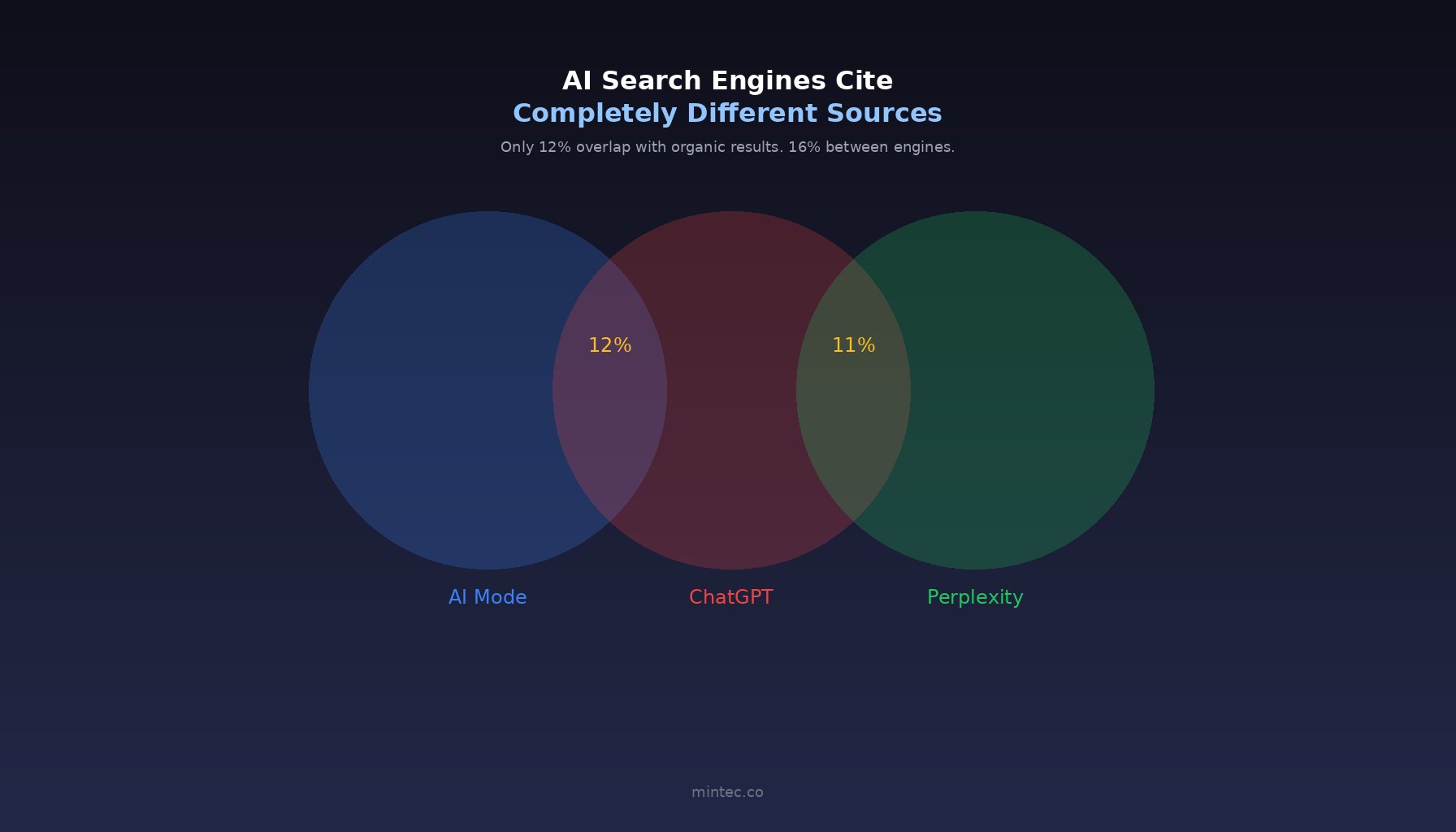
- Your own presence. Check if your brand appears in AI answers and where that citation comes from. Citation profiles differ per engine, so what ChatGPT cites isn't what Perplexity cites.
After the audit, the next step is the same as always: publish content a model can't replace. Real traffic from AI arrives when the citation rests on owned data, not formatting. The path to getting cited by ChatGPT didn't change because of this case. What changed is context: now you know citations can be bought, and engines will react.
What to do this week (not just watch)
- Run the provenance audit on your 5 main queries. Open the sources each engine cites, look for authors, history, and ecosystem. If you find a byline-less "study" in your category, note it: there may already be dirty competition in your niche.
- Document your authority before someone questions it. A real authors page, with bios and verifiable LinkedIn profiles, is no longer optional. It's the cheapest signal an engine can verify, and the one the Hanover Institute didn't have.
- Publish one owned data point this fortnight. A benchmark, a customer survey, a real cost measured by your team. Owned data is the citation that can't be fabricated or replaced, and it's the core of the strategy we described in how to earn genuine ChatGPT citations.
- Monitor your own citation profile. Run the same queries a buyer would run and note which sources appear next to your brand. If something looks off, you got there early: there's still time to report it to the engines and publish the correct version of the facts.
Acting now has an advantage: standards are about to rise. Sites with demonstrable authority will inherit traffic from the ones that vanish when filters tighten. Your job this week is to be in the first group.
My take: this accelerates provenance filters
The part few people are saying out loud: this case gives engines the perfect excuse to restrict which domains are citable. OpenAI will tighten its policies, Google will adjust what it treats as a reliable source, and credibility criteria will matter more than ever. Brands that build real authority, with visible authors and owned data, come out stronger. Brands that depended on appearance vanish from answers within a week.
The lesson for your strategy is simple: don't chase the citation, build the source. A byline-less report is disposable. A data point only your company holds is not. Your brand in AI search is decided on that.
One last thing: the next time an AI answer cites a "study" or a "report," look for the signature. No author means no study. It means AI Story Optimization.
Frequently Asked Questions
What is AI Story Optimization?
It's the practice of creating content designed to look credible to large language models so they cite it in answers. The Hanover Institute case documented it: a firm paid by a government published 100+ byline-less 'reports' in a week and got ChatGPT and Perplexity to cite them in neutral tests.
Is AI Story Optimization the same as GEO?
No. Legitimate GEO optimizes real content, with named authors, verifiable data, and earned reputation. AI Story Optimization fabricates the appearance of authority: no bylines, no track record, paper-format pages built to fool an engine's credibility heuristics. One is marketing, the other is fraud.
How do I know if an AI answer is citing a fake source?
Run the provenance audit: does the site have named authors with a track record? Does it have publication history predating the AI era? Is it cited by real media or databases? If the answer is no in all three, treat the source as suspect until proven otherwise.