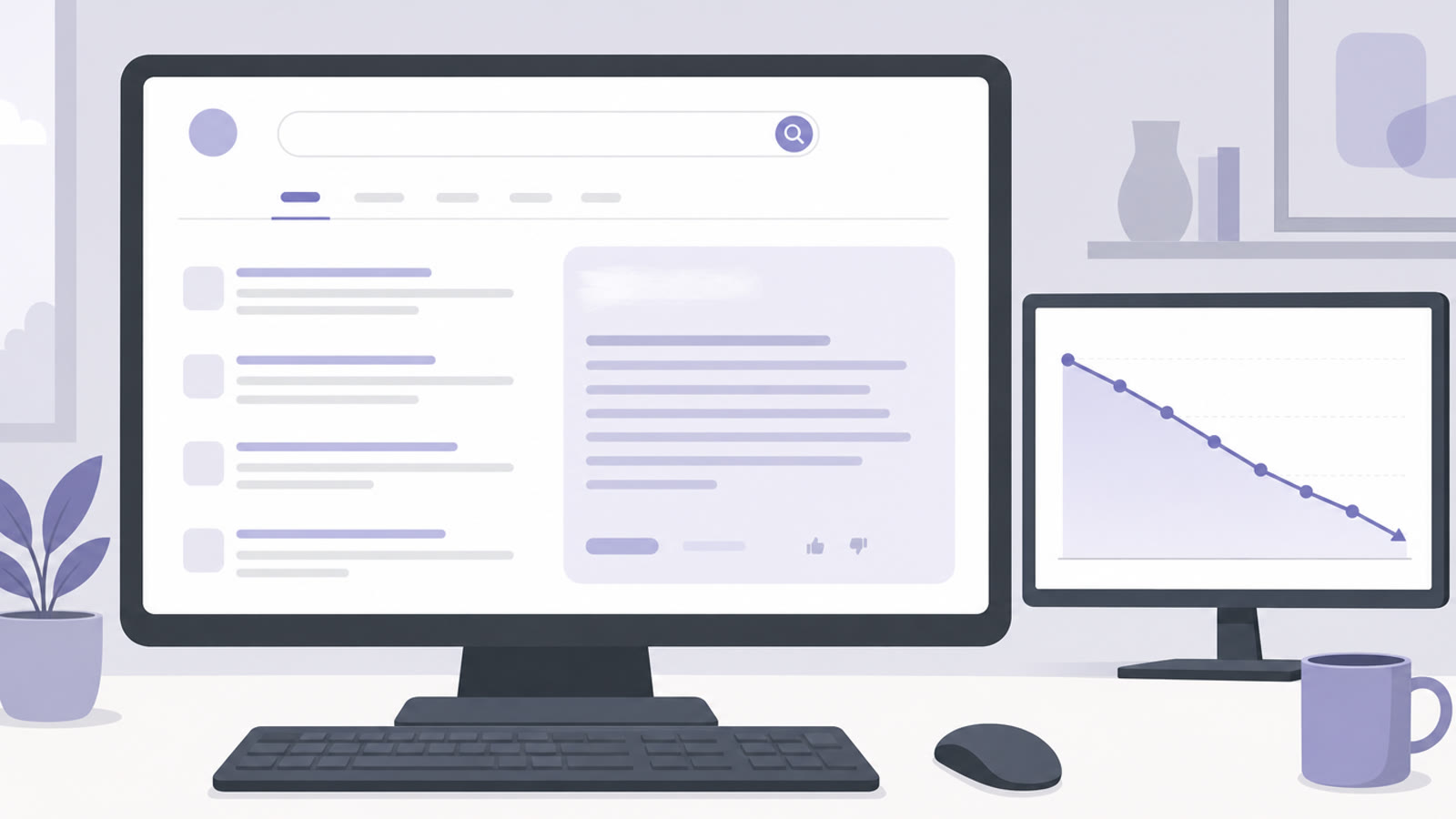

A rank tracker's empty day is a sampling failure, not a ranking failure
On Nov 18 a tracker's deliveries fell to 1.6% of a normal hour. Why the surviving rows move your average position, and the row-count check to run first.
On November 18, 2026, one rank tracker collected 1.6% of a normal hour's search results at its lowest point, and 11.6% of normal across a ten-hour stretch, on every one of the five upstream providers it buys from — inside the window of Google's November core update. So the first number to read on a rank report is not the position. It is the row count for the period. Missing rows are not a smaller sample of the same population; they are a different population, and averaging them produces movement nobody measured.
That is the whole argument. What follows is the dated evidence, the arithmetic that breaks, and the four checks that keep a gap out of your report.
What the data actually shows
Nozzle, which sells SERP collection, published its own throughput on November 18. Deliveries fell to 1.6% of a normal hour at the low — a 98% drop — and came in at 11.6% of normal from 13:00 to 23:00 UTC. Every one of the five providers it collects through fell to 2% or less of its own baseline in its worst hour. Four of the five delivered under 8% of normal across the ten hours; the fifth reached about 30% because it recovered for an hour and then fell again. One provider reported that CAPTCHAs on its iPhone requests went from roughly 19% to roughly 90%.
Search Engine Journal covered it on November 23 and added two things worth keeping. The tracker's numbers describe its own collection and cannot prove other vendors saw the same drop. And the fallout coincided with a core update that Google announced on November 10 with a rollout "up to 2 weeks" long, still marked incomplete when the article was reviewed on November 22.
The backdrop is a change in how Google serves results at all. On November 16 a tester searching in incognito was shown a "Sign in to continue" page on his first query, and others reproduced it the same week. Rajan Patel, Google's VP of Engineering for Search, replied publicly on November 17: "Looking into this. I don't believe it's meant to happen on the first page of results like this but we may be testing something here." Since late August, results have also been served through google.com/goto redirects, and providers report that following those links is throttled per results page — the limit follows the page, not your IP or your query, so rotating either one does not help.
Put those four facts in one paragraph and the reporting problem is obvious. A rank tracker is not a measuring instrument pointed at Google. It is a buyer of a data feed that Google can slow, gate or shape, and on November 18 that feed narrowed to about a tenth of its usual width for most of a working day.
Why a missing row is not a small row
Here is the part that costs people money. Treat a gap as missing data and you widen your confidence interval. Treat it as a smaller sample and you assume the rows that survived look like the rows that did not. Neither is true.
Collection pressure does not fall evenly. It falls on whatever is most expensive to fetch, and what survives is whatever the pipeline gets to first. Take twenty tracked keywords, nineteen sitting at position 9 and one at position 40 — a plausible portfolio with one long-tail term. The reported average is 10.55.
Lose that one row and the remaining nineteen average 9.00. You have just published a 1.55-position improvement across the portfolio, with no ranking change anywhere, because the row that vanished was the one holding the average up. Run it the other way and a throttle that hits only head terms reports a collapse that never happened. Either direction is a number nobody measured.
| What the report says | What actually happened | Check that exposes it |
|---|---|---|
| Average position improved 1.5 spots | The long-tail row failed to return | Rows returned ÷ rows requested |
| Impressions down 40% | Same keywords, fewer fetches | Keyword count in each window |
| Position collapse on the 18th | Ten hours of 2% delivery across providers | Per-provider delivery curve |
| Movement in one tool only | One vendor's capacity, not the SERP | Two providers, same query set |
There is a second, quieter bias. Averages are not the only output at risk: the keyword-level history your dashboard keeps will show a gap where a fetch failed, and most tools draw a straight line through it. Nobody looks at the line. They look at the twelve-month chart in the monthly meeting, where one missing week now reads as a trend.
The four checks before any rank delta
None of these takes more than twenty minutes, and all four can run before a client sees anything.
1. Delivery rate against its own baseline. Per provider, per day: rows returned divided by rows requested. Compare it to the trailing 14-day median for that provider, not to yesterday. Below about 70% of median, the period is void for reporting and gets annotated as a collection failure.
2. Population overlap. Count the keywords that returned in both windows you are comparing. If that number is lower than the number of keywords you track, you are not comparing the same portfolio, and no position delta is valid until you say so in the footnote.
3. Provider agreement. If you buy from two providers, do both show the move? A movement that exists in one feed and not the other is a capacity story, not a ranking story. Vendors fail independently; Google's ranking does not.
4. First-party direction check. Pull the same window in Search Console at query level. Google's own guidance for core updates is explicit: confirm the rollout finished, then wait at least a full week after it completes before analyzing, and compare that week to the one before the start. A rank tool cannot tell you when the rollout completed. The Search Status Dashboard can, and that date — not the date of your chart — sets the window.
The rule I would put on the wall: if the row count moved, the only number you may publish is the row count. Everything else is a statement about a population you did not choose.
What Search Console can and cannot replace
The reason to prefer first-party data here is not accuracy. It is auditability. Search Console cannot be put behind a login wall on a Tuesday morning, and when it breaks, Google logs the break: the Generative AI performance report under-logged impressions from November 9 to 11, 2026, and that anomaly is published. We wrote about that failure separately, because it is the mirror image of this one — a first-party logging gap with a public notice, instead of a third-party collection gap with none.
What Search Console does not give you is the thing you bought a rank tracker for: a position on a specific results page, for a specific keyword, against a competitor set, on a date you choose. Its average position is impression-weighted over a sampled dataset, and its quirks are real — links inside an AI Overview all inherit the block's position, as our note on AI position counting lays out. A stable position with no clicks is a separate failure that rank data will never explain either.
The division of labor that survives contact with reality: Search Console for demand, direction and anything you will defend in a meeting; rank data for SERP composition — who else is on the page, which features fire, what the answer block cites — and only for periods whose delivery rate you have checked.
That boundary just moved in your favor. On November 16 Google added three capabilities to the Search Analytics API: a brandedClassification dimension and filter, a webMultimodal search type covering Lens, Circle to Search and image uploads, and a filterLists field for multi-country and multi-device pulls in one request. More of the reporting that used to require a third-party feed can now be built on data Google signs. Read the limits before you rebuild anything: branded classification applies only to eligible top-level properties with sufficient query and impression volume, returns no rows otherwise, cannot be combined with a query filter in the same request, and its data starts on February 21, 2026.
Two failures that do not announce themselves
A blocked request fails loudly. That is the good kind of failure, and it is the one last week gave everyone.
The bad kind comes back looking normal. Nozzle has documented "poisoned" results pages — synthetic SERPs returned instead of real ones, where nothing on the page tells you the sites you expect are missing. In its tests, most SERP APIs came back 50% to 60% poisoned on page one, some above 90%. There is no header, no gap, no error. Just a page of results that are not the results.
That is the failure mode to design against, and it is the same one that haunts every AI visibility tool. Those tools are collectors too: they ask answer engines a set of prompts and record what comes back. When a provider degrades, the answer you get may still look like an answer. There is no Search Console for generative surfaces to reconcile against, which is exactly why an agent's impressions and a customer's impressions have to be counted separately rather than merged into one visibility number.
The practical consequence is uncomfortable for anyone reporting on rank or AI citations: you are monitoring a vendor's throughput, not the market's behavior, and most dashboards do not show throughput at all.
The rule
Count rows before you read rank. Never compare two windows whose row counts differ by more than a third, and never let a tool's blank day become a client's bad month. When the index is deciding how much of itself to serve, search results are a supply-constrained feed, and a feed that thins out silently is a feed you stop averaging.
If your reporting stack cannot answer "how many rows came back" for last Tuesday, that is the first thing to fix — before the next core update, not during it. Our SEO and GEO work is built around that question first, and a conversation is usually faster than rebuilding a dashboard alone.
Frequently Asked Questions
Did rank trackers stop working in November 2026?
No. On November 18 one tracker's results collection fell to 1.6% of a normal hour at its lowest point and stayed near 11% for about ten hours, and every one of the five upstream providers it buys from dropped to 2% or less of its own normal in its worst hour. Collection recovered. The problem is what the surviving rows do to an average when nobody notices the gap.
How do I know a rank movement is real and not a data gap?
Count rows before you read position. Take the number of keyword-result rows returned for the period and divide it by the number you requested. If that ratio is below about 70% of the tracker's trailing 14-day median, void the period: the average you can compute from the remaining rows is an average over a different set of keywords, not a smaller version of the same one.
Can Search Console replace a rank tracker?
Not entirely. Search Console is first-party, cannot be locked behind a login wall, and now exposes branded classification, multimodal search and multi-country filters through its API. But it reports average position weighted by impressions, not a per-keyword position on a specific results page, and it exposes no competitor set. Use it for direction and demand, and use rank data only for SERP composition when its delivery rate is stable.